


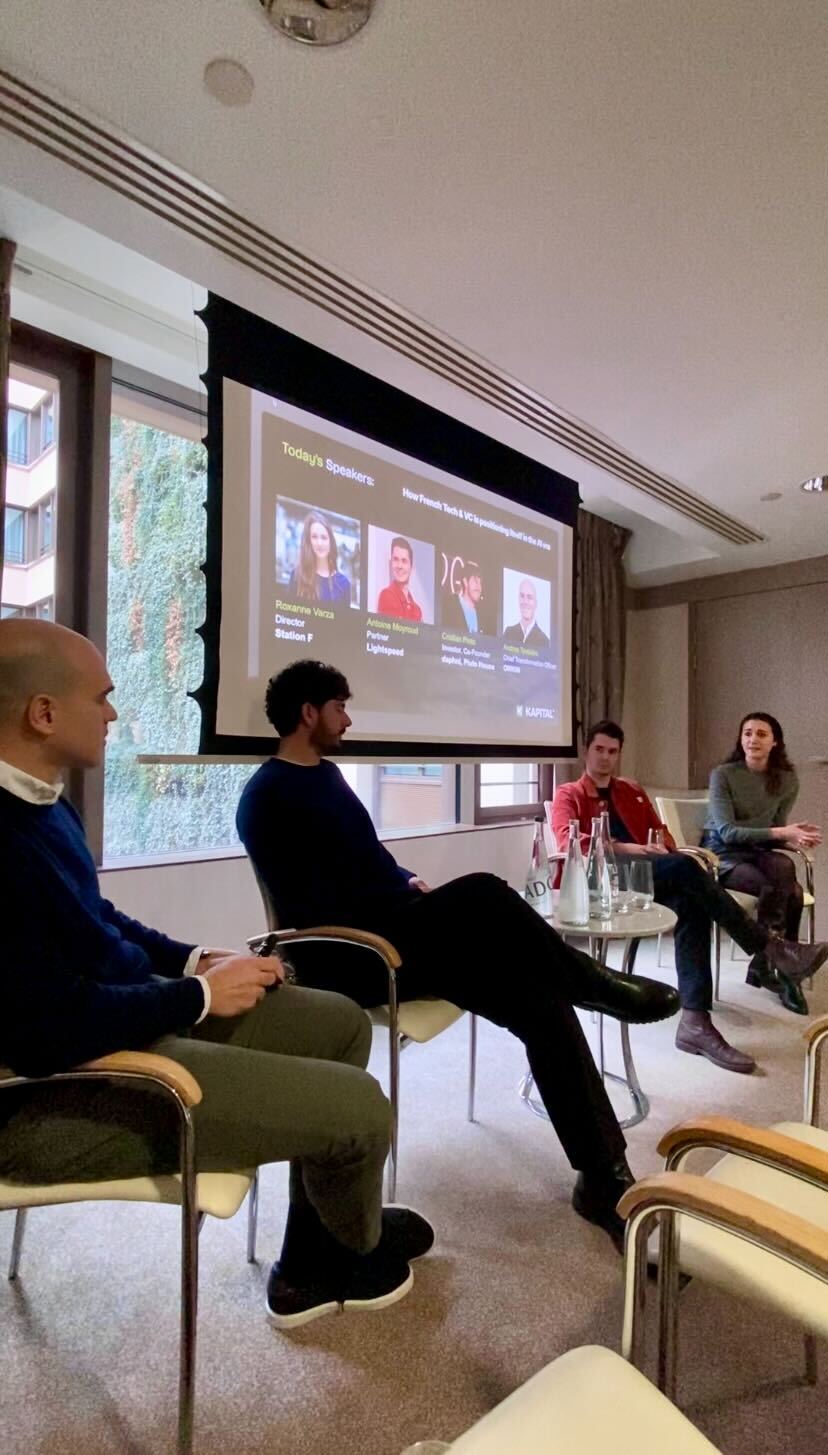
It was our pleasure to bring together 3 of French tech ecosystem's most active builders to discuss France's rise in positioning itself as a global leader in AI at KAPITAL's latest Private Market Perspectives lunch. Panelists: Roxanne Varza (Station F), Antoine Moyroud (Lightspeed Venture Partners), Cristian Pinto (daphni / Pluto House). Moderated by Andrea Tassistro (OWKIN).Moderated by Andrea Tassistro.
Setting the Scene
Three of the French tech ecosystem's most active builders sat down to tackle a question the industry can't stop asking: can Europe - and France in particular - become a genuine global force in AI, or will it always be playing catch-up with Silicon Valley?
On stage: Roxanne Varza, Director of Station F; Antoine Moyroud, Partner at Lightspeed Venture Partners (investor in Mistral AI and Naboo); and Cristian Pinto, Principal at daphni and co-founder of Pluto House, Europe's first AI hacker house. The conversation ranged from capital strategy and ecosystem design to talent pipelines, regulation, and whether the era of cheap software actually changes the VC math.
1. Station F Launches F/AI — Europe's Most Connected AI Program
The freshest news on the panel came from Roxanne Varza: the launch of F/AI, Station F's dedicated program for ambitious AI founders. After nearly nine years and 9,000 companies, Station F is doubling down on AI with an unusually dense coalition of partners - 16 AI leaders including OpenAI, Mistral, Anthropic, Meta, Google, Microsoft, Hugging Face, Lovable, and Clay, backed by eight top-tier funds: Lightspeed, Sequoia, General Catalyst, 20VC, Seedcamp, and others.
The goal isn't just access to compute or cloud credits. It's about connecting founders directly to the right decision-makers at the right moment — the gap that most often separates a European startup from its American equivalent. Critically, the program is explicitly international: the current cohort already includes teams from Pakistan, the UK, and beyond, and 80% of F/AI founders are repeat or multi-exit founders — a stark contrast to Station F's early days, when first-timers dominated.
Roxanne's key ambition: attract the very best global founders to build their AI companies in Europe, including pulling US-based founders across the Atlantic.
"We want to build the leading place to build AI in Europe." Roxanne Varza · Director, Station F
2. The Real Revenue Gap — and Why It's Not About Founder Quality
One of the panel's sharpest moments came when Antoine Moyroud pushed back on a common piece of European self-criticism. When foreign investors ask why European startups don't hit €1M ARR faster, the answer isn't that European founders are less capable. It's that US enterprise buyers move faster.
American organizations have a cultural willingness to test, pilot, and purchase software quickly — and that procurement speed creates a compounding advantage. YC's power, Antoine argued, is essentially a self-fulfilling machine: founders sell to other founders, hit metrics fast, raise bigger rounds, and repeat. Europe lacks that internal flywheel.
The implication isn't pessimism — it's a design challenge. F/AI is explicitly structured to solve for this by creating warm introductions to enterprise buyers, not just investors. And Lightspeed itself doesn't lower the bar for European companies: when Antoine told Naboo's CEO that the best Series B companies grow 5–7x, the initial reaction was shock — but Naboo, now expanding into the UK and US faster than its French home market, is on that trajectory.
"It's not a question of the caliber of the founders. It's more a procurement and buying mentality that is different." Antoine Moyroud · Partner, Lightspeed
3. Capital Is Concentrating — and Europe Is Starting to Catch Up
The conversation on funding rounds was one of the most nuanced parts of the discussion. The apparent paradox: if AI is making software cheaper to build, why are rounds getting bigger?
Antoine's answer: at the extreme end of the market, you're not funding software — you're funding bets on fundamental breakthroughs. The Sequoia $1B round being discussed was for a researcher in reinforcement learning considered a top 0.01% person globally — someone whose work at DeepMind (AlphaZero, AlphaProof) points toward a potential path to generalized intelligence. When the upside is capturing a meaningful percentage of global GDP, a small group of funds with deep enough pockets will rationally concentrate enormous capital around a handful of people, regardless of geography.
Europe is beginning to see this logic play out domestically. Mistral's mega-rounds established the pattern. And each of these raises does something beyond funding the company — it acts as a talent magnet, with senior Silicon Valley engineers now reaching out to be connected to Arthur Mensch or Yann LeCun. That's a new dynamic.
4. Pluto House — Betting on Density and Ambition Over Pedigree
Cristian Pinto's story is one of the panel's most unexpected: a US visa blocked by the first Trump administration led him to Europe as a construction worker, then a construction tech founder, then a VC, and eventually to co-founding Pluto House — a one-month residential hacker program for 10–12 elite technical founders at a time.
The thesis is simple but powerful: you can't change the culture of an entire continent, but you can engineer the right peer group. Pluto House screens hard for technical excellence and ambition — and explicitly not for CV logos or which school someone attended. In 10 months, the program has hosted over 50 founders from 30 nationalities, with more than €12M raised by alumni.
One standout story: a Chinese team that arrived barely speaking English built a full foundational model in a month, maxed out their Google Cloud credits in five days, and became the first cohort member to close funding. The broader insight: the top 1% of founders is excellent everywhere — the difference is taste, context, and the peer group you surround them with. And crucially, Trump's policies are now inadvertently driving brilliant Indian, Chinese, and European talent toward programs like Pluto House, since many can no longer access US visas or positions.
"You cannot change the ambition or culture of a whole continent. But if you create a small enough peer group and a small enough place, you can actually spark insane levels of it." Cristian Pinto · Investor, daphni / Co-founder, Pluto House
5. Europe's Genuine Edges — Talent, Loyalty, Lifestyle, and First-Principles Thinking
Perhaps the most energizing thread of the session was the panel's pushback on the reflexive negativity that dominates "tech Twitter" discourse about Europe. Several genuine, structural advantages emerged:
Mathematical and scientific depth. As AI shifts from pure software to problems requiring physics, chemistry, and first-principles reasoning, European educational systems — particularly in France — produce exceptional talent. Pluto House founders in YC were reportedly considered among the strongest on raw intellectual ability.
Talent loyalty and cost. European engineers are less prone to the constant job-hopping of Silicon Valley, and salaries remain meaningfully lower — making the unit economics of building a technical team here more favorable.
Political stability as a competitive edge. In a moment of genuine uncertainty about the trajectory of US institutions, Europe's relative stability is starting to register as an advantage, not just a talking point.
Lifestyle pull. The CTO of Meta reportedly told a Station F session that many Bay Area engineers dream of working in Europe — they just don't know how to make it happen. Station F's largest non-French cohort has always been Americans. That's not new, but it's accelerating.
Regulation as forcing function. Rather than treating GDPR and EU AI Act as purely negative, European founders who learn to operate within constraints often develop more creative, defensible product approaches than those who can simply pitch ambition and raise $5M on it.
6. The Coordination Problem — Think European, Not French
The panel's most provocative structural argument came from Antoine, who suggested he'd scrap the French Tech national initiative in its current form. Not because France's ecosystem is weak — it's clearly not — but because the national framing is the problem.
The US doesn't compete as Ohio vs. California vs. Massachusetts. It competes as a single market, a single talent pool, a single buyer base. Europe, by contrast, has governments whose political incentives are national, not continental. Macron championing Mistral as a "French" company was great for attention and support — but it may have limited how the world perceives it as a European champion.
Antoine's prescription was direct: the path to building something globally consequential runs through becoming the European winner first — not the French winner. Mistral already embodies this, with technical teams spread across Poland, Switzerland, and the UK, and a pan-European investment base that makes the "French AI champion" label feel increasingly narrow. The ask to Europe's ecosystem builders: stop competing on which city has the most unicorns and start acting as a single, dense, coordinated node. The talent is there. The capital is growing. The ambition is real. What's missing is the collective will to think at continental scale.
7. France's Structural Headwinds — The Harder Conversations
The panel didn't shy away from the friction points. Two in particular stood out as underappreciated barriers on the ecosystem.
The language problem. French companies have historically stayed French-speaking all the way through Series C — and that creates a quiet but real barrier to attracting international C-suite talent. Senior executives who relocate their lives for a role often arrive to find an all-French internal culture that makes integration genuinely difficult. Antoine's prescription: brute-force it. Hire two or three non-French-speaking senior leaders simultaneously to shift the internal default, in the same way you'd enforce a gender diversity policy. The good news: a new generation of French founders is building English-first from day one. But for many existing scale-ups, this remains an operational drag and a subtle signal that limits the global quality of people they can attract.
The labor law barrier. Cristian Pinto flagged the issue that generates the least public debate but causes real operational damage at the earliest stages: European labor law rigidity. In France, letting go of a founding engineer who isn't working out can carry obligations equivalent to 30 months of salary. For a pre-Series A startup operating on a tight runway, that is an existential constraint on the risk-taking that early company-building demands. Pluto House actively factors labor law environments into its advice on where founders should incorporate. EU Inc and other structural reform proposals were acknowledged by the panel — but none of them expect current initiatives to meaningfully touch the labor law question anytime soon.
8. The Exit Problem — and Why M&A Matters More Than IPOs Right Now
Perhaps the ecosystem's most persistent structural weakness, and the one that compounds all the others, is the exit market. Varza shared a striking data point from a Station F internal poll: over 50% of early-stage founders have no exit strategy at all, and only 16% believe an IPO is a realistic aspiration.
The IPO fix is a long game. Euronext lacks the cultural cachet and institutional depth of NASDAQ, and that gap won't close quickly. The more actionable near-term lever is M&A — and Varza called explicitly for European scale-ups and large corporates to become more acquisitive within the ecosystem. A recent acquisition of a Station F company by Mistral was cited as exactly the kind of precedent that should become commonplace.
Antoine pushed back gently on the idea of M&A as an act of European solidarity. The only acquisitions that create lasting value are ones driven by genuine quality — Mistral didn't acquire a Korean AI team out of patriotism, they did it because the team was exceptional. Protectionist acquisition logic ultimately weakens the ecosystem it's trying to protect.
The deeper structural issue, as Antoine framed it: Europe's largest companies — with a few notable exceptions like SAP and ASML — are not technology leaders. You can't expect LVMH or L'Oréal to be natural acquirers of deep-tech startups if they haven't yet made the internal transition to being technology-first businesses themselves. Until that changes, the M&A flywheel that recycles founder capital and experience back into the ecosystem will remain underpowered.
Key Takeaways
For founders: Europe has real structural advantages — lower burn, stronger technical depth, improving access to capital, and a regulatory environment that, while challenging, builds resilience. The revenue ramp gap is real but solvable through the right buyer networks. Build English-first from day one, think European from day one, and choose your incorporation jurisdiction carefully.
For investors: The best European founders are benchmarked against global peers, not a separate European standard. Rounds are growing because at the frontier of AI, the prize justifies the risk — and that calculus is geography-agnostic. The talent pipeline is improving; the exit infrastructure still needs work.
For ecosystem builders: Density and peer group quality matter more than location. The talent is flowing toward Europe in part because of US political dynamics. Programs like F/AI and Pluto House are proving that deliberate ecosystem design can compress timelines that geography and culture would otherwise slow down.
For policymakers: The incentive structure needs to shift from national wins to European coordination. Labor law reform is the unglamorous intervention that would unlock the most risk-taking at the earliest stages. The ecosystem is ready — the political and regulatory scaffolding hasn't caught up yet.
The Role of KAPITAL
KAPITAL supports asset and wealth managers by making private market allocations bankable, scalable, and operationally effortless, including:
- Structuring SPVs and feeder funds with ISIN codes
- Managing the legal, administrative, and operational process
- Enabling partners to scale private market allocations without building heavy internal infrastructure
This article is part of KAPITAL’s Private Market Perspectives event series. To learn more, contact the team at arman@kapital.inc


