

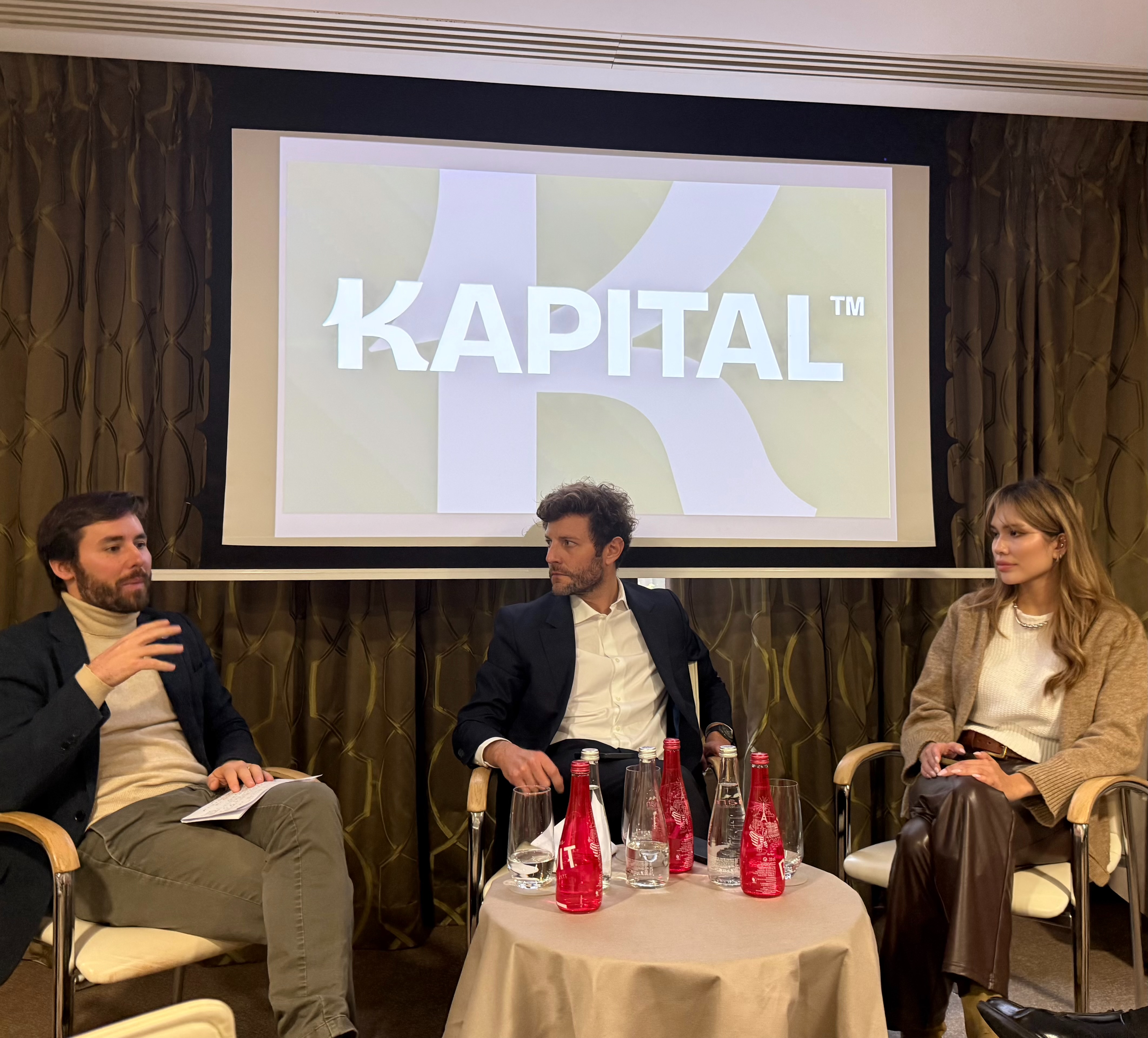
At the latest edition of Private Market Perspectives in Paris, KAPITAL welcomed Nicolas Marin, Managing Partner at ROKA, and Arthur Derrey, Founder of DGI and advisor to leading family offices including HBS, who shared their experience on how families allocate capital into real estate, why Paris remains a unique market, and what it takes to navigate today’s more selective landscape.
The discussion gave a clear and practical view on value creation, allocation behaviour, risk management, and execution.
A New Phase for Real Estate Investing
Nicolas opened the session by retracing more than 20 years of experience across AXA, Allianz, Chelsfield, and the Olayan family’s European real-estate portfolio. His track record includes redeveloping iconic assets on Avenue Montaigne and across the Triangle d’Or. ROKA, the firm he launched almost four years ago, follows that same approach, targeting value-add and core-plus assets in prime areas of Paris.
ROKA has now executed eight acquisitions representing over hundreds of million in assets and ongoing development works, with its latest transaction finalized earlier this week alongside HBS for which KAPITAL supported a bankable solution for part of the investment. The strategy remains consistent: selective, hands-on, and focused on irreplaceable locations.
Arthur, drawing from years at J.P. Morgan, Blackstone, and his own advisory firm, explained how real estate has become a core component of family-office allocation. Historically driven by tangible appeal and emotional connection, the asset class is now attracting families for another reason: it delivers resilience, clarity, and visibility in a volatile macro and political environment.
How Families Allocate Today
Both speakers agreed that private-market allocations have evolved sharply in recent years:
• Demand is client-driven. Families want access to private markets, led by a broader industry narrative pushing alternatives as a core allocation.
• Liquidity trade-offs are now better understood. Families historically accustomed to daily-priced public markets now appreciate the stability of quarterly valuations.
• Real estate remains emotionally resonant. Families want to visit assets, picture the transformation, meet operators, and understand the story.
Arthur noted that while venture and late-stage growth investing attracted attention during the previous cycle, family offices today return to fundamentals: buyout, real estate, and selected special-situations strategies where pricing has normalized.
Paris Real Estate: Challenges, Shifts, and Opportunities
Nicolas described the past three years as a period of measured instability. The Paris market is still strong, but value now comes mainly from execution, not from changes in yields.
• Companies continue to migrate toward the best locations. Many accept smaller spaces outside Paris to secure a prime address in the city’s core districts.
• Vacancy in central Paris is still low, around 4 to 5 percent, compared with double-digit levels in the suburbs.
• Real value comes from what you do with the asset. Re-tenanting, architectural restructuring, mixed-use approaches, and targeted redevelopment have become central to performance.
Political and macro uncertainty adds a layer of hesitation for international investors. Arthur highlighted that many U.S. and Middle Eastern families are watching the French political environment closely and need strong fundamentals before committing capital.
That same hesitation sometimes opens doors. Buyers step aside, pricing adjusts, and families with long-term conviction can find attractive entry points.
“It’s a selective market, but it still offers windows to act,” Arthur noted.
A Case Study: ROKA x HBS x KAPITAL
A highlight of the session was the discussion around the latest acquisition, a landmark transaction on Rue Lincoln in the Triangle d’Or, executed with HBS and supported through KAPITAL.
The asset consists of four connected buildings totaling 5,000 sqm, including a hôtel-particulier, majority office surfaces, and high-end residential units. The acquisition came through an off-market opportunity that added strong appeal and scarcity value.
Nicolas detailed the transformation plan:
• Early architectural and redevelopment work already underway
• A high-quality buyer pipeline for the hôtel-particulier
• A strategic découpe (unit-by-unit sale) for the office buildings
• A location where supply remains structurally scarce
On the execution side, Arthur highlighted the essential role of KAPITAL for HBS’ investment in this project:
“The deal required speed, precision, and a structure that could accommodate multiple families with different banks and operational requirements. The bankability and efficiency of KAPITAL’s issuance platform made this possible. If the structuring process is heavy or unreliable, it becomes a nightmare for everyone. With KAPITAL, it was smooth, fast, and fully aligned.”
Nicolas added:
“It was one of our best acquisitions to date. The execution with HBS and KAPITAL was fluid and dependable. Whenever the banks required documentation, the process moved cleanly. It made a very complex transaction manageable.”
This collaboration illustrates KAPITAL’s core value: enabling wealth managers to access private-market opportunities they could not efficiently execute alone.
What Families Want: Alignment, Track Record, and Tangibility
When selecting operating partners, Arthur emphasized three criteria:
- Alignment of interest. ROKA invests significant capital alongside its investors.
- Deep operator expertise. Especially in Paris, where regulation, PLU constraints, and competitive dynamics demand local market insight.
- Prudent underwriting. Families expect discipline, not projections built on unrealistic rent growth or assumptions.
Real estate may be emotional, but discipline is the differentiator.
Looking Ahead: Selectivity, Execution, and Patience
Both speakers agreed on what will define the next phase of family-office real-estate allocation:
• Hyper-selectivity: From 200+ opportunities per year, only a handful merit serious consideration.
• Prudence in underwriting: With rent ceilings and political uncertainty, conservative assumptions matter more than ever.
• Greater importance of operator quality: Families want partners who deliver, document, and communicate.
• A return to fundamentals: Core-plus and value-add strategies anchored in prime locations remain the most resilient.
• Opportunities from market dislocation: Pricing resets create entry points, but only for investors with patience and conviction.
Nicolas summarized it simply:
“It is the right moment to enter the market, if you know exactly what you are doing.”
Arthur added:
“For families, the key is choosing the right partners. In a complex environment, execution and discipline matter more than anything else.”
The Role of KAPITAL
KAPITAL supports asset and wealth managers by making private market allocations bankable, scalable, and operationally effortless. This includes:
• Structuring SPVs and feeder funds with ISIN codes
• Managing the entire legal, administrative, and operational process
• Delivering predictable 4–6 week execution timelines
• Enabling partners like HBS, investing into assets like ROKA, to scale without building internal infrastructure
As private wealth increasingly shapes the future of private markets, KAPITAL provides the platform that allows asset and wealth managers to focus on what matters most: selecting the right investments.
This article is part of KAPITAL’s Private Market Perspectives series.
For more information about upcoming editions in Geneva and Paris, please contact Elisabeth Sünder at elisabeth@kapital.inc.


